
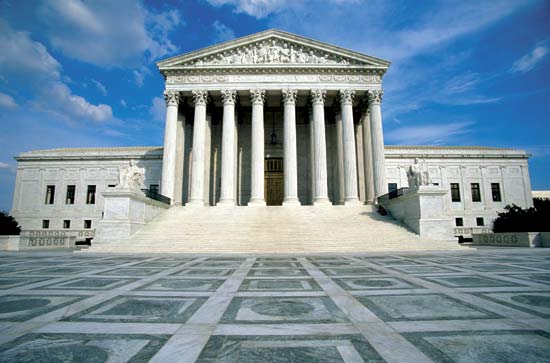
 The unexpected death of Supreme Court Justice Antonin Scalia may have major effects on many pending Supreme Court cases involving unions, immigration and employment law.
Only eight justices are likely to sit on the court for the rest of the year while there is an anticipated battle over who Scalia’s successor will be. This leaves the court vulnerable for a 4-4 legal tie, which would leave lower court decisions in place.
Here are the 5 most important cases for businesses to pay attention to in the absence of Scalia:
- Environmental Protection Agency’s Climate Rule
The Supreme Court halted the Environmental Protection Agency’s regulation for power plants while challenges to the rule are being reviewed by the U.S. Court of Appeals for the D.C. Circuit., only days before Scalia’s death. Businesses were among the most adamant groups seeking the suspension of proceedings.
Since this issue is still in appeals court, a case challenging the Environmental Protection Agency’s rule will not come before the Supreme Court this term, and may not come before the court in the term that begins in October.
Scalia made up part of the five-person majority who voted to stay the rule, so his successor will play a key role in deciding the Supreme Court ruling on this issue.
- Immigration
President Obama’s executive action regarding immigration caused much controversy last year. His actions opened the door for millions of undocumented immigrants to obtain legal status.
The legal challenge to President Obama’s executive action could have far-reaching effects on industries that rely heavily on immigrant labor. Expect this issue to remain a hot-button topic for the years to come.
- Employment Law
There are several employment law cases put before the Supreme Court that could be decided by 4-4 split vote cases.
One of these cases is CRST Van Expedited v. Equal Employment Opportunity Commission, which will be argued in March. The case relates to when the Equal Employment Opportunity Commission has to pay a company’s legal fees after its claim against the company is dismissed. A tie vote would uphold the lower court’s decision that the company is not entitled to attorney fees.
Another pending case that could be decided by a 4-4 vote is Green v. Brennan. This case regards when the statute of limitations period for a specific type of claim against an employer begins. A split 4-4 vote would uphold the lower court ruling which is favorable towards businesses.
The Tyson Food v. Bouaphakeo oral argument, to be heard by the Supreme Court in November, will help determine who qualifies to be part of a class action lawsuit. Scalia was responsible for casting the 5-4 majority rulings on this question in the past. Therefore, a split vote in the Tyson Food case would allow for the appeals court’s decision, which required a multi-million dollar verdict against the company, to stand.

- Friedrichs vs. California Teachers Association
One of the most important pending cases for businesses to watch regards the California Teachers Association and if public employees who are not union members can be required to pay union fees.
Small businesses are especially concerned with this ruling because they can pay higher taxes due to expensive union contracts. The National Federation of Independent Business saw the Friendrichs case, which was argued in front of the Supreme Court in January, as a major opportunity to overturn the decision from the 1970s that upheld forced union dues.
- Puerto Rico
The Supreme Court will hear Puerto Rico v. Franklin California Free Trust in March. Puerto Rico has been taken to court by bond investors over a law it passed allowing itself the ability to restructure its debt.
Puerto Rico’s appeal court sent it to the Supreme Court following the lower court overturning the territory’s law.
Scalia’s death further complicates an already muddy situation because Justice Samuel Alito removed himself from the case, possibly because of some financial holdings that could be impacted. This means that in March, only seven justices will hear the argument.
Follow the EPAY Systems blog to stay on top of these developments.